Interviews

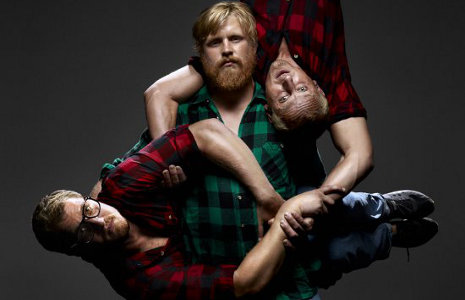
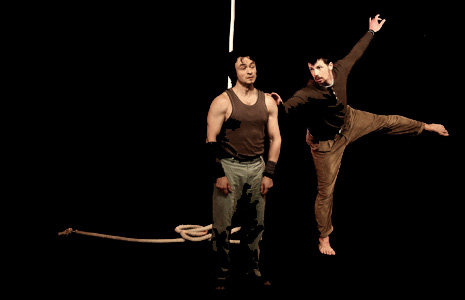
Cirk La Putyka, La Putyka | Photo: Martin Faltus

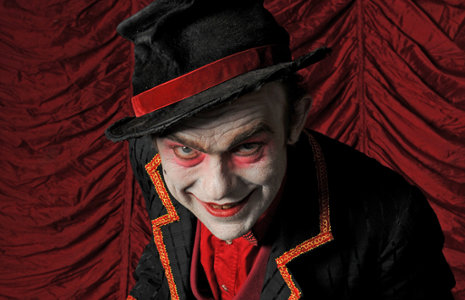
'Many times we were exploring the technique and training the technical elements at the same time as we were drawing a dramaturgical line – which for this show has evolved around our La Putyka, around barmen and the destinies of people who can meet each other at a pub. We draw from much authentic experience and many adventures. For example the closing song was written by my father when he was receiving treatment for alcoholism in rehab. In Bohemia the song has its own magic, an unworldly quality, but also a great depth, describing what else, apart from cheer, alcohol and its demons can bring to a human being. I wonder how it's going to work in English...'

Director Rostislav Novak on the work of the Czech company Cirk La Putyka.

read more
Marie-Louise Masreliez, What About Charlotte

'Every artist has a story about themselves. 'I always knew that I was a mover'... 'I could never sit still in school'... 'I just couldn't write, knew that I had to move' – and this story is not enough for me. I always try to go deeper and find what their motivation was. Often we come to a breakpoint, the moment where they took the decision to become a circus artist, and I try to make them remember that breakpoint and what was important for them at that point and how it has changed since.'

Sideshow talks to the director Marie-Louise Masreliez about her devising method, Motion Participatory Choreography, and the piece What About Charlotte.

read more
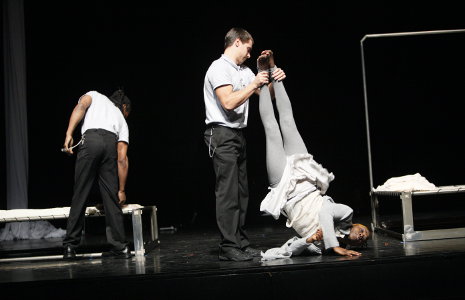
Upswing, Fallen

'I think storytelling for me doesn't come from England, it comes from my heritage – storytelling in Africa, in Ghana, its not just entertainment, it's a means of communication. When I talk to my mother – it's hard to explain... even the language in Africa: something that can be said in a couple of words in English, the same phrase in Africa is a much, much more flowery phrase. It's much more proverbial and things are told in analogies and connections, so I think I've been brought up with that interest in stories.'

Upswing's artistic director Vicki Amedume talks to Sideshow about her background in traditional circus, her interest in working stories into non-text-based work, the particular problems and quirks of devising circus, and where all these strands meet: the company's new show, Fallen.

read more
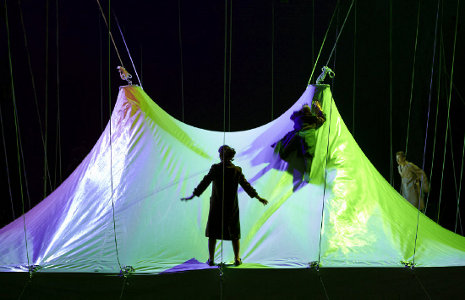
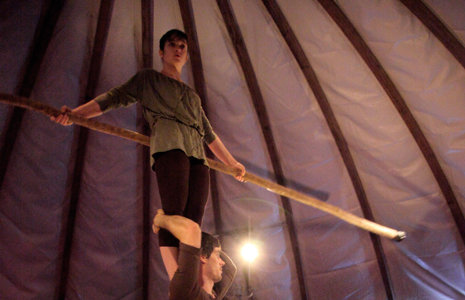
Théâtre d'un jour, L'Enfant qui... | Photo: Anne Baraquin

'And we need a tent, a little tent, because we want to present the work in a real proximity with the public – putting them close to tragic sensations, and to fear, and all the sensations we can find in the traditional circus. Theatre now is more in the head, and we try to find physical sensations in the public, letting them react to what happens here on stage.'

A striking show at Festival Circa 2010, Théâtre d'un jour's L'Enfant Qui... is an oblique, ethereal portrait of an ill child, inspired by the early life of the sculptor Jephan de Villiers. Here Jephan and Théâtre d'un jour director Patrick Masset talk to Sideshow about their collaboration.

read more
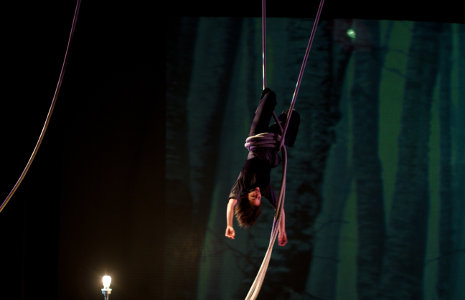
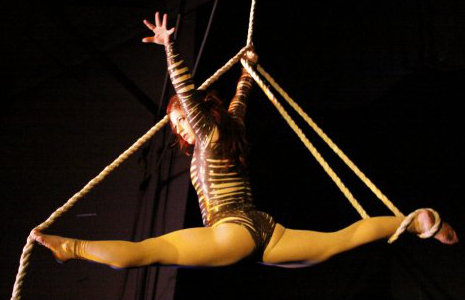
Shayna Swanson, Inbetweetime

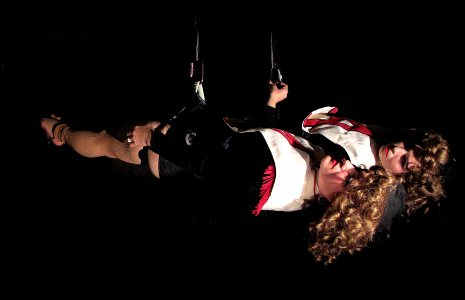
'When I first started developing the act I was thinking, OK I want to make something really pretty, something really beautiful and, you know, in quotes, "pretty". And I started working that way and it just wasn't clicking and it wasn't coming together and I realised i'm not a pretty artist, it doesn't work for me. I don't have long arms and long legs. I'm powerful like a gymnast, so I have to make something that's powerful like that. And that's how I've always loved to move. I don't love to move in a dancerly way. I love to move in an aggressive way.'

Aerialist Shayna Swanson talks to Sideshow about her Mallakhamb-influenced rope solo Inbetweentime.

read more
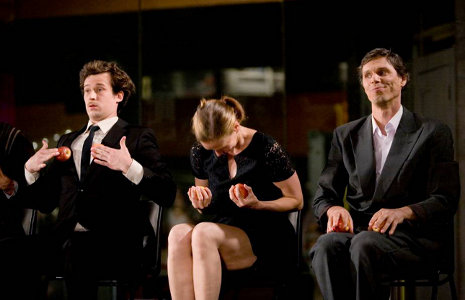
Gandini Juggling, Smashed!

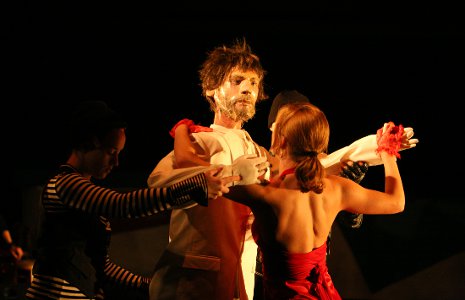
'I think the Pina Bausch thing ended up being stronger than we imagined—in my mind it was lightly inspired by Pina Bausch and it came out strong. I'd say it's only recently that her influence has come in. I'd say that maybe our early work was closer to our other hero, Merce Cunningham. Maybe NightClubs was a little bit more related to Merce's work and mathematics and complex space and all of that, and certainly all our early work was working with complex spatial arrangements. With Pina actually it's terrifying when you see her work because you just realise how much everyone's got out of it. Kontakthof and Café Müller are extraordinary and beautiful works. They hover at the back of your brain those pieces...'

Sideshow talks to Sean Gandini about Smashed!, the commission piece from Gandini Juggling's 2010 Watch This Space residency, and a work of beautiful destruction and perversity.

read more
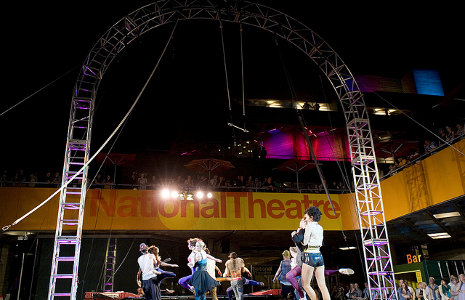
Watch This Space Festival | Photo: Ludovic des Cognets

Now in his sixth year programming the National Theatre's three-month, outdoor mega-festival Watch This Space, Angus MacKechnie talks to Sideshow about the WTS residencies, stretching the budget, and pulling in the Alan Bennett audience

read more
InStallation | Photo: ©deutsch

Originally made in just five days and performed for four nights to an audience of friends in the tiny stables of Switzerland's Circus Monti, InStallation has since moved into a tent and toured some of Switzerland and France's largest festivals. Following a UK performance at Milton Keynes' IF Festival, one of the creators, Roman Müller, talks to Sideshow about staying faithful to the intimacy and roughness of those first performances.

read more
Green Eyed Zero, In the shadow of picture frames

'We're developing a multitouch screen—a bit like an iPhone but much bigger. I'm developing a programme, an application, that is currently working on a small-scale prototype, where we can zoom in and manipulate objects on the screen. Then we'll make it to a larger scale. And then with this theme of folie a deux [a madness shared by two], the underlying idea for the touchscreen is to show "impossible" things and how in the mind you can develop paths that are completely wrong.'

Sideshow interviews Sebastien Valade and Rachel Pollard of Green Eyed Zero about remotely operating their sound and tech cues while performing on stage, the place of technology in their work, and their plans for a new show.

read more
6½ Flying Circus, Canto  | Photo: Pietro Motisi

'My desire to create work in non-conventional places, my desire to create work in what became a label, 'site-specific', comes not from a trend. I've been doing it for 25 years. And why? Because live performance—and I'm not calling it theatre or otherwise, I'm calling it live performance—is 150 years behind the visual arts. Live performance is still very much, in terms of how it is being read, is very much that proscenium arch left-to-right without ever challenging the thinking process of the viewer.'

Sideshow interviews director Firenza Guidi about her work on 6½ Flying Circus' first show, Canto - The Last Flying Chance in the North; her long-term collaboration with NoFit State; her collaborations with space; and lab work on NoFit State's new piece for the hated pros arch.

read more
Cirkus Cirkör | Photo: Mattias Edwall

'I've worked a lot with circus artists, artists that are in Inside Out but also other artists, to find out what is the knowledge that they have about taking risks and balancing and dealing with the physical risk that they always have. But also with the mental... with the life situation in one way. A lot of circus artists, they prefer to have a moving life all over the world instead of having a house and a safe, secure living. And also a lot of circus history has been worked in—so a lot of the stories or the characters in the show have flavours from historical artists or stories.'

Sideshow interviews Tilde Björfors, artistic director of Cirkus Cirkör, about the company's super-success Inside Out, their collaboration with Irya's Playground, and their continuing work with research scientists in exploring the physical and neurological effects of circus.

read more
John-Paul Zaccarini, Beside Myself | Photo: Mark Morreau

'We go into the circus because we know that there isn’t a script. We’re not playing someone else. I know actors will say “when I’m playing Macbeth I’m not playing someone else, I’m playing the Macbeth inside”, and that’s one school of acting. But essentially we go into circus because we don’t want to do someone else’s thing. We want to do our act. So what we’re doing is telling a personal—a really personal—story there. So why do you need another story?'

Circus and rope artist John-Paul Zaccarini talks about Circoanalysis—a blend of circus and psychoanalysis that aims to strip everything back to find the metaphors and stories at circus’ heart.

read more
Muziektheater Transparent, Feedback | Photographer: Virginie Schreyen

NoFit State at the Roundhouse, L’Amour de Loin at the English National Opera, Circa at Riverside Studios—a lot of the season’s biggest circus has fronted the City Circ label. Here Sideshow interviews Pam Vision and Marie Remy (Associate Producer and General Manager at Crying Out Loud, who're managing the project) about how the first year went and their plans for the future.

read more
Circa, C!rca | Photo: Justin Nicolas

A short interview with Circa artistic director Yaron Lifschitz, talking mostly about his work on the latest show C!rca.

'I think, though, ultimately, circus functions like a poetry cycle rather than a narrative. Like I think it is the ultimate actual real-time artform. I find that circus that makes too much of its connectivity, its threads, generally doesn’t interest me very much. I figure the juxtaposition, placement, quarrels between things are as interesting as, you know, "narrative" for want of a better word. Our work isn’t narrative-based.'

read more
Like Sideshow on Facebook or be haunted forever by your missed opportunities

Newsletter


Sign-up for Sideshow's montly newsletter.

Search

Latest Articles